
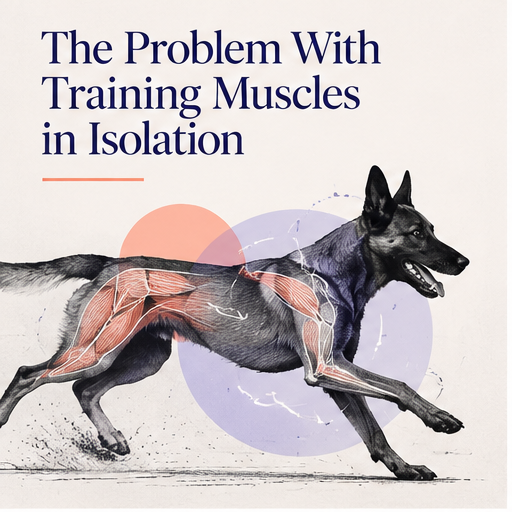
The Problem With Training Muscles in Isolation
By Melanie Uhde, PhD · K9 in Motion
Walk into any gym and you will see people doing leg curls, bicep curls and calf raises: one muscle, one joint, one movement at a time. It is a tidy way to think about strength, and it is how most of us were taught anatomy, one muscle at a time with an origin, an insertion and an action.
So it is natural to bring that thinking to our dogs.
"His hamstrings look weak, so let's do a hamstring exercise."
"She needs a stronger core, so let's do a core exercise."
There is some truth in that. But it is also where a lot of well-meant conditioning goes sideways, because dogs don't move one muscle at a time, and they can't really train that way either.
Muscles work in teams, not solo
Anatomy books list each muscle with "its" action, but the same books are clear that a movement is a team effort. For conditioning programs, I generally keep the four roles a muscle can play in any movement in mind:
Prime movers (agonists) produce the movement.
Antagonists do the opposite action. Far from switching off, they relax in a controlled way so the movement is smooth and precise.
Fixation muscles hold joints steady while the prime movers work.
Synergists stabilize the joints higher up the limb so the prime mover's force actually reaches the joint further down.
Take a simple elbow extension. The triceps is the prime mover, but without the muscles around the shoulder holding that joint still, the force of the triceps would leak away into a wobbly shoulder instead of straightening the elbow. A dog with a perfectly strong triceps and poorly controlled shoulder will still push off badly.
This is the first problem with isolation: a muscle that is strong on its own is not the same as a muscle that works well in its team.
Many muscles cross more than one joint
The second problem is that many of the big movers in a dog's body cross two joints at once. In the hind leg:
The rectus femoris, part of the quadriceps, crosses both the hip and the stifle (knee). The quadriceps' actions include extending the stifle and flexing the hip.
The hamstring group (biceps femoris, semitendinosus and semimembranosus) runs from the pelvis down past the stifle. Depending on the part of the muscle and the phase of the stride, these muscles extend the hip, flex or extend the stifle, and even help extend the hock.
What a two-joint muscle does at one joint depends on what is happening at the other. A hamstring that is extending the hip during push-off is working in a completely different situation from a hamstring flexing the stifle while the paw is in the air. You can't train "the hamstring" in one position and expect it to be ready for every job it has in a gallop, a jump or a tight turn.
Dogs can't really isolate anyway
I find myself repeating this to clients often: dogs can't grip a barbell, they can't sit on a machine and swing one leg, and they can't easily isolate a single joint. Almost all canine conditioning relies on gravity and the dog's own body weight, with the paws on the ground or on equipment.
That is what's called a closed kinetic chain: the paws stay planted while the joints above them move. When your dog goes from a down to a stand, the paws stay put while the elbows, stifles and hocks straighten, and the force travels up through the whole limb and into the trunk. These closed-chain exercises are generally more stable and more functional, precisely because nothing is working alone.
An open kinetic chain is the opposite: the paw is free in the air, as in swimming or a cued paw reach. These exercises are better at singling out specific muscles, and they have their place. But for most of what our dogs actually do (stand, walk, sit, jump, land, turn), the paws are on the ground and the whole chain is working.
Movement happens in three planes
A third problem with isolation thinking is that it usually trains movement in one direction only: forward and back. But movement in real life is multi-dimensional:
Forward and back (sit-to-stand, down-to-stand, bows).
Side bending, where the spine curves left or right (circling, figure eights, wraps around a cone).
Rotation and sideways movement, where the limbs move away from or toward the body and the trunk twists (side-stepping, quick changes of direction, the twist of a disc dog catching a frisbee).
A dog can be very strong in a straight line and still be weak the moment it has to turn. If the strengthening program only ever trains one plane, it leaves the dog unprepared for the other two, and the other two are often where injuries happen.
So is isolation always wrong?
No, and I want to be fair here. Assessing muscle groups such as the quadriceps, hamstrings, back muscles and abdominals and finding real imbalances is valuable. Some dogs have big, toned quadriceps and weak hamstrings; others have strong back muscles and weak abdominals. When an imbalance like that is clear, it makes sense to target the weaker group.
The key word is target, not isolate. In practice, targeting means choosing whole-body, closed-chain exercises that put a bit more of the load on the group that needs it, while the rest of the team still has to do its job. For example:
A incline sit-to-stand loads the hip and stifle extensors, but the core still has to keep the spine neutral.
Backing up asks the hind legs to drive while the dog coordinates all four limbs.
Weight shifting with the paws anchored trains the trunk and limbs to hold a position together.
Each of these has a main target, and each also trains the team.
What this means for your dog
If you take one thing away from this post, let it be this: strength only counts if your dog can use it in the way they actually move. When I build a conditioning plan, I'm not asking "which muscle is weak?" in isolation. I'm asking:
What does this dog need to do in everyday life or in their sport?
Which links in the chain aren't keeping up?
Which whole-body exercises load those links while still training the team?
Are we covering all three planes of movement, not just forward and back?
That way the work we do in a session turns into better movement on the trail, in the ring or on the couch-to-car jump.
Curious what your dog's weak links are? Book a free 30-minute call and we'll talk it through.