
The Limits of Proprioception Training
By Melanie Uhde, PhD · K9 in Motion
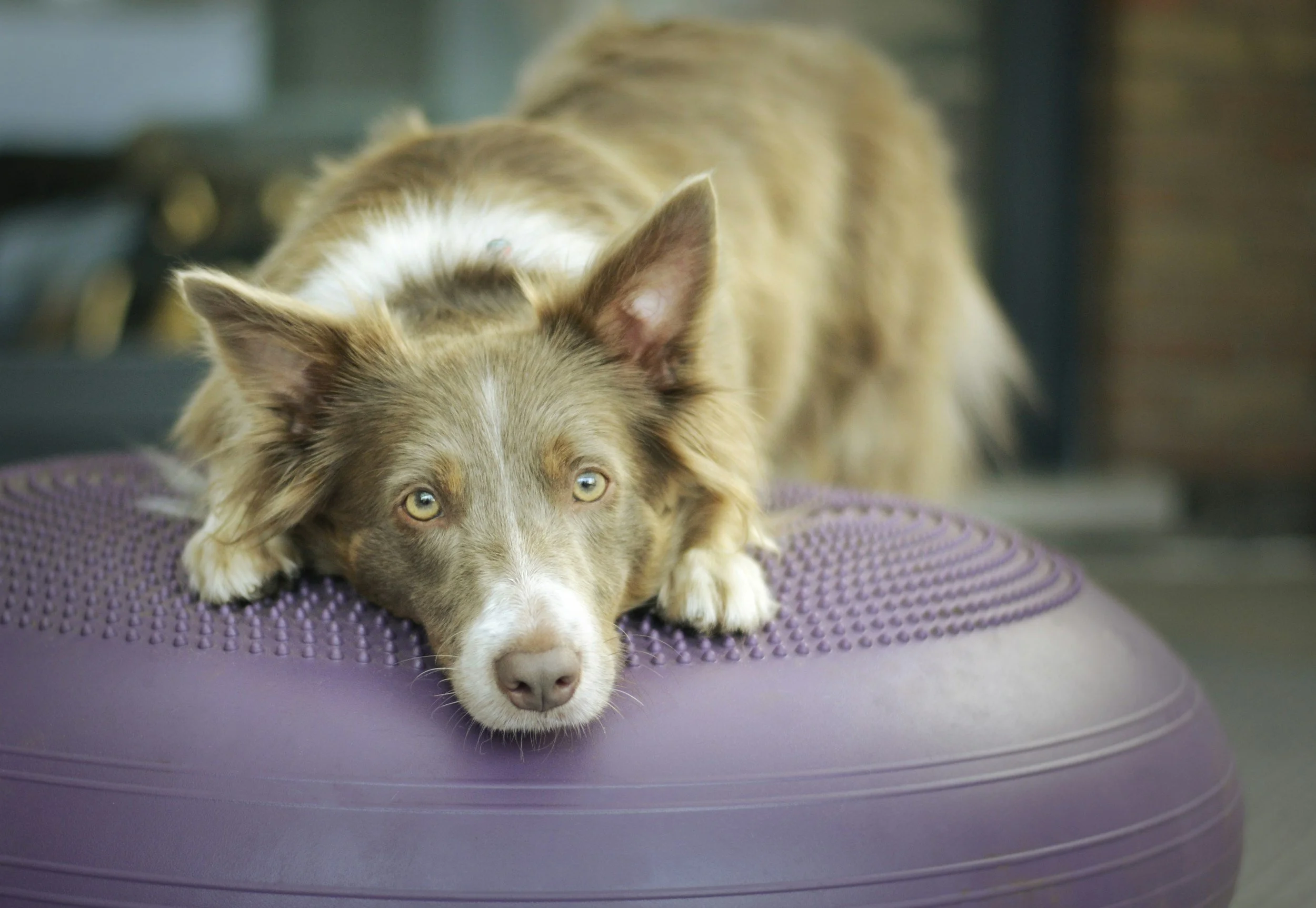
Wobble boards, balance discs, peanut balls, wobbly cushions: if you follow dog fitness on social media, you've seen a lot of dogs standing on things that move. Proprioception training has become the face of canine conditioning, and for good reason. It's valuable, it's fun, and it looks impressive.
But I think it's worth being honest about what it can and can't do. Proprioception is one important piece of a fit, resilient dog. It isn't the whole picture, and it can't make up for the pieces that are missing.
What proprioception actually is
Proprioception is your dog's sense of where its body is in space: where each paw is, how bent each joint is, and how the body is moving, without having to look. This information comes from the inner ear and from sensors in the muscles, tendons, joint capsules and ligaments. These include:
Muscle spindles, which report muscle length and so help signal joint position through the range of motion.
Golgi tendon organs, which sit where muscle meets tendon and respond to tension.
Joint receptors in the joint capsule and ligaments, some of which mainly fire near the ends of a joint's range during movement.
The brain combines all of this to coordinate movements like landing from a jump or scrambling over uneven ground. These pathways are trainable: with practice, the connections get stronger, and dogs get better at it.
We generally differentiate between four kinds of proprioceptive work:
Multi-joint active movements: placing front or back feet on a target without looking at it.
Goal-directed reaching: targeting something the dog can see, like a paw-to-hand touch, with precision.
Dynamic exercise: controlled, active movement through range, like many dynamic stretches.
Balance training: small adjustments of weight and limb position to stay steady, including any work on wobbly or squishy surfaces.
That's a broad toolbox, and wobble boards are only one corner of it.
Limit 1: Knowing where your leg is doesn't mean you can hold it there
This is the big one. Joint stability during movement is the result of two things working together: proprioception (the sensing) and neuromuscular control (the muscles responding with the right force at the right time).
A dog can have excellent awareness of its stifle position and still not have the strength to keep that stifle steady when it lands from a jump. Sensing a problem is only useful if the muscles can do something about it.
Here is a related practical point: for building strength in the big muscles, the best results come from good form on mainly stable surfaces. Unstable surfaces are great for balance and body awareness, but they aren't the most effective way to build raw strength. A program that is mostly wobble work can leave a dog well-coordinated but underpowered.
Limit 2: You get good at what you practice
In my post on specificity I wrote that the body gets good at exactly what you ask it to do. That applies here too. A dog who has practiced standing on a balance disc for months gets very good at standing on a balance disc. Whether that carries over to a tight turn on wet grass is a separate question.
The human research on knee-ligament injuries shows this clearly. Effective programs don't stop at general balance work. They progress in stages:
Learn to respond to wobbles and nudges from all directions.
Add light sport-specific movement during those challenges.
Finish with sport-specific positions at higher intensity.
The goal is for the athlete's muscles to respond accurately to disturbances like the ones they'll meet in their sport. For our dogs, that means proprioceptive work should progress toward the movements your dog actually does, not stay parked on a disc.
Limit 3: Much of the evidence comes from people
Several proprioceptive training programs have been shown to reduce injury rates, but those studies are in human athletes. And I honestly think there is a similar problem with other conditioning concepts: the human research is often inconsistent, and we're then extrapolating it to a different species with different anatomy.
That doesn't make proprioceptive training useless. It means we should be modest about the claims.
"This will prevent injuries" is a bigger promise than the dog-specific evidence supports.
"This is likely to help as part of a balanced program" is more honest.
Limit 4: Sloppy reps train sloppy patterns
Proprioceptive exercises only work if the dog is actually controlling the position. We need to emphasize slow, focused movements and clear criteria for success at each step, because that's what makes the exercise about body awareness rather than scrambling. Slow work also makes it easier to spot early signs of fatigue.
Limit 5: It's one component, not the program
There are five components of a balanced exercise program: strength, endurance, balance, body awareness and flexibility. Proprioception covers two of them. It doesn't build an aerobic base, it doesn't replace strength training, and it doesn't create range of motion a dog doesn't have.
How I actually use it
I love proprioceptive work, and I use it in almost every program. Here's how I keep it in its lane:
As a foundation: front, rear and four-paw targeting with good form, teaching the dog to notice and control where its feet are.
Simple and on the ground: Walking slowly through a ladder on the ground, stepping over randomly placed poles, and backing up over sand, wood chips or long grass. No fancy equipment needed.
Combined with strength: once form is solid, I combine body awareness with strengthening, and build most of the raw strength on stable surfaces.
Progressing toward real life: the end goal is better control in the movements this particular dog does every day.
Proprioception teaches the body to notice. Strength, endurance and flexibility give it the ability to respond. A resilient dog needs both.
Want a balanced plan for your dog? Book a free 30-minute call.