
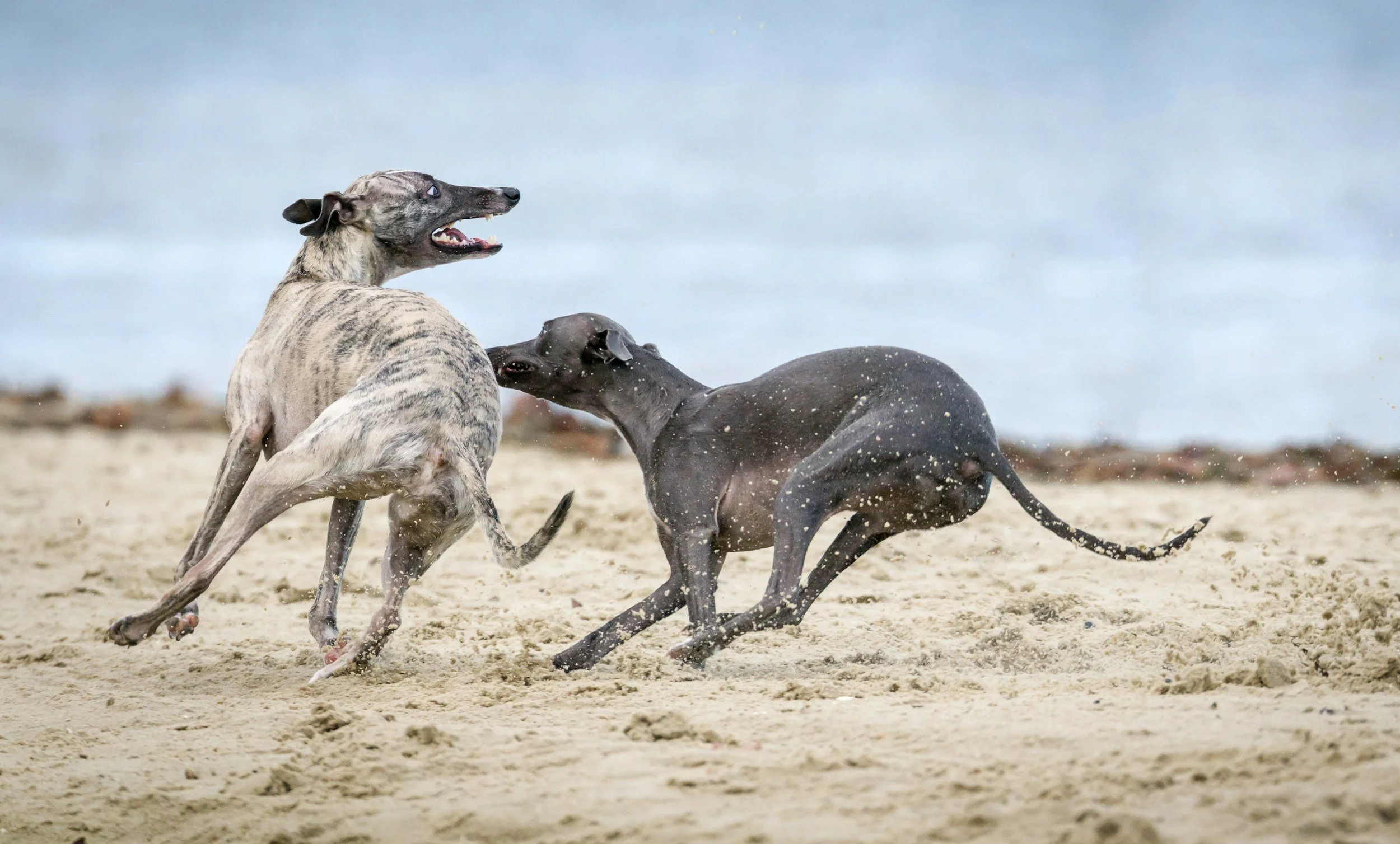
Strength Is Specific. So Is Weakness.
By Melanie Uhde, PhD · K9 in Motion
If you've ever played tennis regularly, there's a good chance your racquet arm is stronger than your other arm. If you compare a marathon runner with a sprinter, their legs look completely different. And a child practising handwriting gets better at exactly that: handwriting, not drawing or throwing.
Those examples illustrate one of the most important ideas in conditioning, for people and for dogs: the body gets good at exactly what you ask it to do.
The flip side gets talked about much less. If strength is specific, then weakness is specific too. A dog isn't simply "strong" or "weak". It's strong in some positions, directions, speeds and situations, and weak in others. Finding those specific gaps is most of my job.
The SAID principle
The formal name for this is the SAID principle: Specific Adaptation to Imposed Demands. In plain terms, when we put the body under a particular kind of stress, it adapts in ways that make that particular stress easier to handle next time.
There are two kinds of adaptation:
Structural adaptations: physical change, such as muscles getting bigger and stronger.
Neural adaptations: better communication between nerves and muscles, so a movement becomes faster, smoother and more precise.
Both are specific. The muscles that do the work grow, and the nervous system gets better at coordinating that exact movement. That's why a dog can look muscular and still move clumsily in a task it hasn't practiced.
There are three things to consider when choosing a strength exercise: specificity (does it target the muscle groups that actually need it?), overload (does the difficulty go up gradually, so muscles have a reason to grow?) and concussion (does it avoid unnecessary pounding?).
Where weakness hides
Because strength is specific, weakness tends to hide in places a general exercise routine never reaches. Here are the ones I see most.
1. In the hind end and core. The front legs carry about 60% of a dog's weight standing, and all of it when jumping, cantering or galloping. The front end gets worked every day just by living. The hind legs and core don't, so they're often the first to fall behind, especially in older athletes. A dog can look fit and still have weak hamstrings or abdominals hiding behind strong shoulders.
2. In one muscle group compared with its partner. It is quite common to find imbalances: big quadriceps with weak hamstrings, or strong back muscles with weak abdominals. Each of those pairs works together to control a joint or the spine, and a gap between them changes how the load is shared.
3. In one side compared with the other. Many sports turn mostly one way. Many dogs have a favourite lead or a favourite side to lie on. Over time, one side gets the practice and the other gets the leftovers.
4. In a direction. There are three planes of movement: forward and back, side bending, and rotation and sideways stepping. Most home exercise routines live almost entirely in the forward-and-back plane. A dog that's strong in a straight line may be weak the moment it has to turn, side-step or twist, which is exactly when a lot of injuries happen.
5. In a type of effort. Imagine a strength–endurance continuum for dog sports. Mushing, herding and field trials sit near the endurance end. Protection sport, flyball, and weight pulling sit near the strength end, with short, intense bursts of under a minute. A dog trained for one end can be under-prepared for the other. Even dogs in short, explosive sports benefit from some aerobic base work.
6. Under fatigue. A dog may hold beautiful form for the first five reps and lose it by rep eight. That loss of form is specific information: it tells us where the system runs out first.
Specific training for a specific dog
If weakness is specific, a generic plan can't fix it. We need to consider six principles of strength and conditioning that keep training targeted:
Individuality: every dog responds differently, so the plan is built around the dog in front of you.
Specificity: train the qualities, movements and directions the dog actually needs.
Overload: keep challenging the body, or it has no reason to keep adapting.
Progression: increase the challenge gradually.
Diminishing returns: early gains come fast. Later ones are smaller and take more precise work.
Reversibility: stop training for long enough and most of the gains disappear. In one study, fit dogs were put on complete rest and showed a significant loss of fitness within three to five weeks.
Specificity applies to warm-ups too: a warm-up should rehearse the movements the dog is about to do, so an agility dog's warm-up looks different from a tracking dog's.
What this looks like in practice
When I assess a dog, I'm not just asking "is this dog strong?" I'm asking much more specific questions:
Which muscle groups are lagging behind their partners?
Is one side doing more of the work?
What happens to form when the movement changes direction?
At what point in a set does form start to slip?
What does this dog's life or sport actually demand: short bursts, long efforts, tight turns, big jumps?
The answers shape the plan. A dog with weak hamstrings and a sport full of sharp turns gets a very different program from a dog with a weak core who mostly hikes.
The takeaway
General activity builds general fitness, and that's a great foundation. But the injuries and performance problems I see usually live in the specific gaps: a weaker side, a weaker direction, a weaker partner muscle, the last few reps. Find the gap, train the gap, and keep training it, because the body only keeps what it keeps using.
Want to find your dog's specific gaps? Book a free 30-minute call.